Hierarchical Queue
Background
In multi-tenant scenarios, queues are a core mechanism for achieving fair scheduling, resource isolation, and task priority control. However, in the current version of Volcano, queues only support a flat structure and lack hierarchical concepts. In practical applications, different queues often belong to different departments, with hierarchical relationships between departments, leading to more refined requirements for resource allocation and preemption. To address this, Volcano latest version introduces the hierarchical queue feature, significantly enhancing queue capabilities. With this feature, users can achieve finer-grained resource quota management and preemption strategies based on hierarchical queues, building a more efficient unified scheduling platform.
For users using YARN, this feature allows seamless migration of big data workloads to Kubernetes clusters using Volcano. YARN's Capacity Scheduler already supports hierarchical queues, enabling cross-level resource allocation and preemption. Volcano latest version adopts a similar hierarchical queue design, providing more flexible resource management and scheduling strategies.
Features Support
- Supports configuring hierarchical relationships between queues.
- Supports resource sharing and reclamation between tasks in cross-level queues.
- Supports setting resource capability limits
capabilityfor each resource dimension, resource entitlementsdeserved(if the allocated resources of a queue exceed itsdeservedvalue, the queue's resources can be reclaimed), and reserved resourcesguarantee(resources reserved for the queue that cannot be shared with other queues).
User Guide
Scheduler Configuration
In the new version, the hierarchical queue capability is built on the capacity plugin. The scheduler configuration needs to enable the capacity plugin, set enableHierarchy to true, and enable the reclaim action to support resource reclamation between queues. The scheduler configuration example is as follows:
kind: ConfigMap
apiVersion: v1
metadata:
  name: volcano-scheduler-configmap
  namespace: volcano-system
data:
  volcano-scheduler.conf: |
    actions: "allocate, preempt, reclaim"
    tiers:
    - plugins:
      - name: priority
      - name: gang
        enablePreemptable: false
    - plugins:
      - name: drf
        enablePreemptable: false
      - name: predicates
      - name: capacity # capacity plugin must be enabled
        enableHierarchy: true # enable hierarchical queue
      - name: nodeorder
Building Hierarchical Queues
A new parent field has been added to the Queue spec to specify the parent queue:
type QueueSpec struct {
    ...
	// Parent defines the parent of the queue
	// +optional
	Parent string `json:"parent,omitempty" protobuf:"bytes,8,opt,name=parent"`
    ...
}
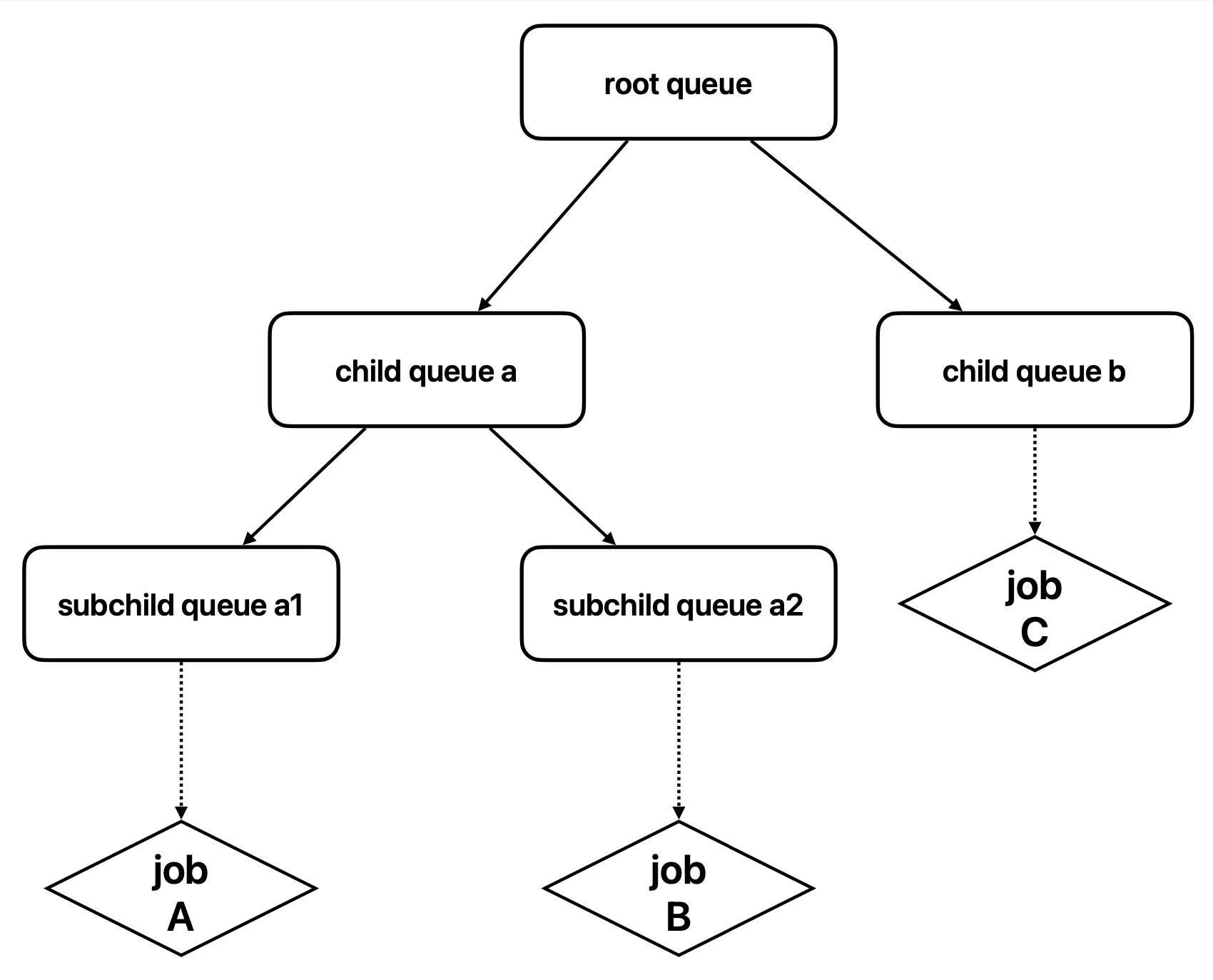
Volcano Scheduler will automatically create a root queue as the root of all queues upon startup. Users can build a hierarchical queue tree based on the root queue, such as the following tree structure:
# The parent of child-queue-a is the root queue
apiVersion: scheduling.volcano.sh/v1beta1
kind: Queue
metadata:
  name: child-queue-a
spec:
  reclaimable: true
  parent: root
  deserved:
    cpu: 64
    memory: 128Gi
---
# The parent of child-queue-b is the root queue
apiVersion: scheduling.volcano.sh/v1beta1
kind: Queue
metadata:
  name: child-queue-b
spec:
  reclaimable: true
  parent: root
  deserved:
    cpu: 64
    memory: 128Gi
---
# The parent of subchild-queue-a1 is child-queue-a
apiVersion: scheduling.volcano.sh/v1beta1
kind: Queue
metadata:
  name: subchild-queue-a1
spec:
  reclaimable: true
  parent: child-queue-a
  # You can set deserved values as needed. If the allocated resources of the queue exceed the deserved value, tasks in the queue can be reclaimed.
  deserved:
    cpu: 32
    memory: 64Gi
---
# The parent of subchild-queue-a2 is child-queue-a
apiVersion: scheduling.volcano.sh/v1beta1
kind: Queue
metadata:
  name: subchild-queue-a2
spec:
  reclaimable: true
  parent: child-queue-a
  # You can set deserved values as needed. If the allocated resources of the queue exceed the deserved value, tasks in the queue can be reclaimed.
  deserved:
    cpu: 32
    memory: 64Gi
---
# Submit a sample vc-job to the leaf queue subchild-queue-a1
apiVersion: batch.volcano.sh/v1alpha1
kind: Job
metadata:
  name: job-a
spec:
  queue: subchild-queue-a1
  schedulerName: volcano
  minAvailable: 1
  tasks:
    - replicas: 1
      name: test
      template:
        spec:
          containers:
            - image: alpine
              command: ["/bin/sh", "-c", "sleep 1000"]
              imagePullPolicy: IfNotPresent
              name: alpine
              resources:
                requests:
                  cpu: "1"
                  memory: 2Gi
When cluster resources are insufficient for pod requirement, pod's resources can be reclaimed. For pods in different queues, they will first reclaim pods in sibling queues (if the allocated resources of the sibling queue exceed the deserved value). If the resources in sibling queues are still insufficient to meet the pod's requirements, the hierarchical structure of the queues (i.e., ancestor queues) will be traversed upward to find sufficient resources. For example, if job-a and job-c are submitted first and the cluster resources are insufficient for job-b, job-b will first reclaim job-a. If reclaiming job-a does not meet the resource requirements, job-c will then be considered for reclaiming.
Note that in the current version, users can only submit jobs to leaf queues. If tasks have already been submitted to a parent queue, child queues cannot be created under that queue. This ensures effective management of resources and tasks across different levels in the queue hierarchy. Additionally, the sum of the deserved/guarantee values of child queues cannot exceed the deserved/guarantee values configured for the parent queue. Each child queue's capability values cannot exceed the capability limits of the parent queue. If a queue does not specify the capability value for a certain resource dimension, it will inherit the capability from its parent queue. If the parent queue and all ancestor queues do not specify it, the value will finally inherit from the root queue. By default, the root queue's capability is set to the total available resources of that dimension in the cluster.
Hierarchical NamespaceQueues
A cluster-scoped Queue can only be created by a cluster administrator. To let tenants build their own part of the hierarchy, Volcano provides NamespaceQueue, a namespace-scoped queue with the same resource fields as Queue (capability, deserved, guarantee, reclaimable, priority). NamespaceQueue is an Alpha feature and is disabled by default. See the NamespaceQueue User Guide for how to enable it, grant tenant permissions and check queue status.
NamespaceQueues extend the cluster queue tree downward:
- The top of every NamespaceQueue tree is attached to a cluster
Queue. The cluster Queue must list the namespace inspec.allowedNamespaces(["*"]allows every namespace). If the field is empty, no NamespaceQueue can attach to it. - In a NamespaceQueue,
parent: cluster/<name>points to a cluster Queue, andparent: <name>points to another NamespaceQueue in the same namespace. Ifparentis omitted, it defaults tocluster/default. - The hierarchy rules above apply to the whole tree, including NamespaceQueues: a queue is limited by the
capabilityof every ancestor, and the totalguaranteeof the children must fit in the parent. For every resource, a NamespaceQueue must satisfyguarantee <= deserved <= capability. - By default, up to 5 NamespaceQueue levels are allowed below a cluster Queue. To change it, set
--max-namespacequeue-depthon both the controller manager and admission. - Workloads reference a NamespaceQueue as
namespace/<name>, which always resolves in the workload's own namespace. An unprefixed name such aschild-queue-bstill refers to a cluster Queue.
The following example lets namespace team-b divide the resources of child-queue-b from the example above into its own sub-queues:
root                                (cluster Queue)
└── child-queue-b                   (cluster Queue, allowedNamespaces: [team-b])
    └── team-b/training             (NamespaceQueue)
        └── team-b/inference        (NamespaceQueue)
# Cluster administrator: authorize namespace team-b on child-queue-b
apiVersion: scheduling.volcano.sh/v1beta1
kind: Queue
metadata:
  name: child-queue-b
spec:
  reclaimable: true
  parent: root
  deserved:
    cpu: 64
    memory: 128Gi
  allowedNamespaces:
    - team-b
---
# Tenant: the parent of training is the cluster Queue child-queue-b
apiVersion: scheduling.volcano.sh/v1beta1
kind: NamespaceQueue
metadata:
  name: training
  namespace: team-b
spec:
  parent: cluster/child-queue-b
  reclaimable: true
  capability:
    cpu: 64
    memory: 128Gi
  deserved:
    cpu: 32
    memory: 64Gi
---
# Tenant: the parent of inference is the NamespaceQueue training in the same namespace
apiVersion: scheduling.volcano.sh/v1beta1
kind: NamespaceQueue
metadata:
  name: inference
  namespace: team-b
spec:
  parent: training
  reclaimable: true
  capability:
    cpu: 32
    memory: 64Gi
  deserved:
    cpu: 16
    memory: 32Gi
---
# Submit a sample vc-job to the NamespaceQueue inference
apiVersion: batch.volcano.sh/v1alpha1
kind: Job
metadata:
  name: job-inference
  namespace: team-b
spec:
  queue: namespace/inference
  schedulerName: volcano
  minAvailable: 1
  tasks:
    - replicas: 1
      name: test
      template:
        spec:
          containers:
            - image: alpine
              command: ["/bin/sh", "-c", "sleep 1000"]
              imagePullPolicy: IfNotPresent
              name: alpine
              resources:
                requests:
                  cpu: "1"
                  memory: 2Gi
Note that a cluster Queue cannot be deleted while a NamespaceQueue is attached to it, and a NamespaceQueue cannot be deleted while it still has workloads, reserved resources or child queues.