MPI on Volcano
HPC introduction
High Performance Computing (HPC) refers to the use of aggregated Computing power to handle data-intensive Computing tasks that cannot be performed by standard workstations.
HPC = PBS + Maui + OpenMPI[1]
- PBS:Resource manager, which is responsible for managing resources for all nodes in the cluster
- Maui:Third-party task scheduler, support resource reservation, support various complex priority policies, support preemption, etc.
- OpenMPI:The upper communication environment, taking into account the functions of communication library, compilation and distributed start task.
openMPI introduction
The OpenMPI project is an open source messaging interface implementation developed and maintained by a coalition of academic, research, and industry partners. Through it we can carry on the parallelization program design.
How is opensMPI implemented
Here is a simple 4-thread MPI program example.
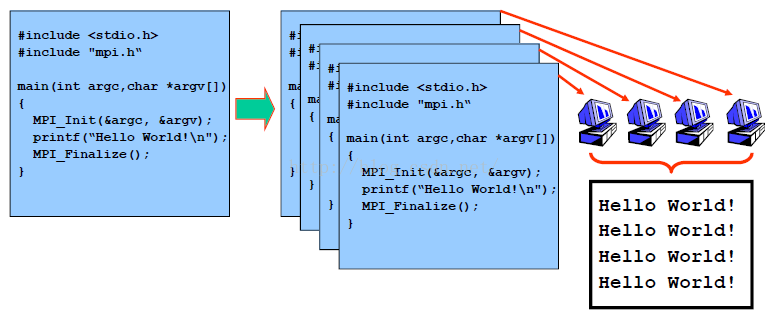
MPI on Volcano
Create mpi-example.yaml.
apiVersion: batch.volcano.sh/v1alpha1
kind: Job
metadata:
  name: lm-mpi-job
spec:
  minAvailable: 3
  schedulerName: volcano
  plugins:
    ssh: []
    svc: []
  tasks:
    - replicas: 1
      name: mpimaster
      policies:
        - event: TaskCompleted
          action: CompleteJob
      template:
        spec:
          containers:
            - command:
                - /bin/sh
                - -c
                - |
                  MPI_HOST=`cat /etc/volcano/mpiworker.host | tr "\n" ","`;
                  mkdir -p /var/run/sshd; /usr/sbin/sshd;
                  mpiexec --allow-run-as-root --host ${MPI_HOST} -np 2 mpi_hello_world > /home/re;
              image: volcanosh/example-mpi:0.0.1
              name: mpimaster
              ports:
                - containerPort: 22
                  name: mpijob-port
              workingDir: /home
          restartPolicy: OnFailure
    - replicas: 2
      name: mpiworker
      template:
        spec:
          containers:
            - command:
                - /bin/sh
                - -c
                - |
                  mkdir -p /var/run/sshd; /usr/sbin/sshd -D;
              image: volcanosh/example-mpi:0.0.1
              name: mpiworker
              ports:
                - containerPort: 22
                  name: mpijob-port
              workingDir: /home
          restartPolicy: OnFailure
---
Delopy mpi-example.yaml.
kubectl apply -f mpi-example.yaml
View job performance under the cluster.
kubectl get pod